Documenting North America's past & present covered bridges


Home

Oroville or Upper Thermalito, Butte County

If you find errors in the data please contact Bill Caswell.

If you would like to provide information on covered bridges that no longer exist from your state, or adopt a state to work on, we would certainly welcome your assistance. Please contact Trish Kane for more information.

Inventory Number: CA/05-04-07x
County: Butte County
Township: Oroville
Town/Village:
Bridge Name: Oroville or Upper Thermalito
Crosses: Feather River
Truss type: (2) Covered Smith Through + (1) Covered Pony
Spans: 3
Length: 481'
Roadway Width:
Built: 1871
Builder: Smith Bridge Company
When Lost: 1905 or 1907
Cause:
Latitude: N39 31.061
Longitude: W121 33.012
See a map of the area
Topographic map of the area
Directions: Just west of the current crossing of Table Mountain Blvd in Oroville.

Oroville or Upper Thermalito Bridge, Oroville, Butte County, CA Built 1871 Lost 1905 or 1907
Todd Clark Collection
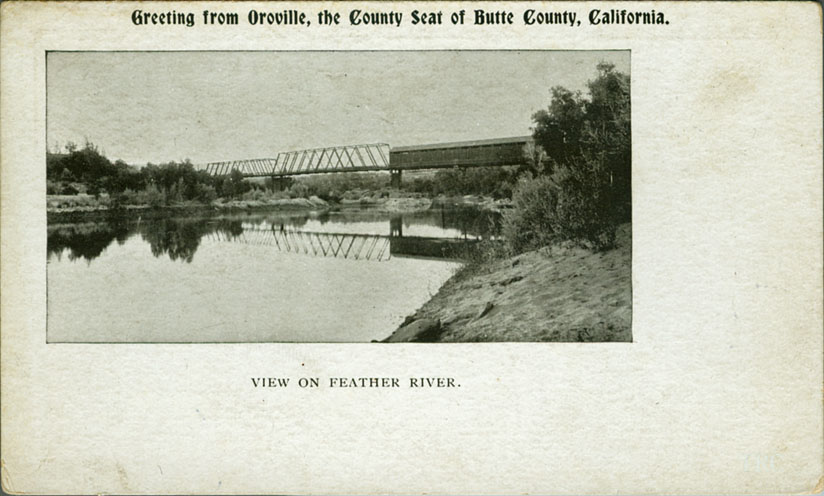

Oroville or Upper Thermalito Bridge, Oroville, Butte County, CA Built 1871 Lost 1905 or 1907
Todd Clark Collection

Comments:
The earliest images of the bridge show a covered bridge, with two covered spans across the main river channel, plus a long covered pony truss on the north side and short connector on the south side. These were apparently the original Smith truss constructions identified in the 12-Jun-1871 reference. Later images show only the south span as covered and the two north spans were both uncovered through spans. It is unclear if the through spans were wooden trusses, but at least one was replaced with a metal span in 1901. The bridge was evidently completely destroyed in a major flood around 1905 (misidentified as 1907 according to CSU archive images), based on pictures available from the CSU Chico Digital Collections. The current steel bridge at the same location, known as the Table Mountain Bridge or Upper Thermalito Bridge, was built in 1906 after the flood. The current crossing is about 660 overall. Per the Vallejo Evening Chronicle, June 12, 1871, "Bridge Building.—The Pacific Bridge Company are framing a bridge for Oroville, at a point near the Railroad crossing, and one truss 420' feet long will be put together about the middle of the week. The Company can build more economically and to better advantage at this point, and when framed the bridge will be sent forward by rail. The whole length of the bridge which is a Smith patent truss is 481 feet and the longest span is 220 feet. The centre will be thirty feet above high water resting upon several tubular iron piers four and a half feet in diameter filled with concrete. The bridge is to be for a double roadway capable of sustaining 80,000 pounds although it will bear a strain of 200,000 pounds, and is to be completed for travel by the 15th of August. This Company built last year 208 bridges in different parts of the Union and this year expects to frame 400. They put up one last year across the Yazoo river having 290 feet span, and have a contract to build two bridges this season across the Platte, each 2,000 feet long." Per The Solano-Napa News Chronicle, July 12, 1871, "Oroville Bridge— The timbers framed here for the Oroville bridge across Feather river have all been sent forward, sixteen cars being required for their transportation. The structure has heretofore been described in this paper, which, when put in place will be a credit to the builders and to Oroville." Per the Oroville Daily Register, July 15, 1899, "There having been so much comment of late regarding the unsafe condition of the Oroville bridge, Civil Engineer O. W. Jasper and George Miller, the well known contractor and bridge builder, were selected to thoroughly examine the structure and report as to its condition. On Friday they rendered their report and the matter of its adoption was taken under advisement. Briefly the report sums up as follows: First, the ends of the chords resting upon the piers of the covered wooden span on the south end, were found to be badly decayed and with many other decayed and broken members, tenders to render it decidedly unsafe. To replace the old span the examiners recommend the construction of two spans and a center stone pier, said pier to cost about $3,900; its base to be 10x40 and its top 5x20; height about 53 feet. The spans to be either combination or steel Pratt trusses housed in. The combination will cost about $3,640, with $400 additional for housing. The steel trusses will cost about $6,370; the amount for housing being the same. Should the Board conclude to repair the bridge it is recommended that as soon as possible the pier be constructed in the center so that when this is done the old span can be repaired, so that the bridge will be good from three to five years longer. The repairs then to be made are specified as follows: By placing long timbers on top of the center piece and along under the chords and strapped thereto, the tension to be taken up by hog chains passing over uprights rising on center pier, the rotten members at ends of chords to be replaced by new timbers. The estimated cost of these repairs, in addition to cost of pier, is about $1000. Second, the gentlemen recommend for the center span a system of lateral bracing to consist of a set of diagonal rods between each panel extending between the ends of cross ties fastened to each set of main braces. A general repair of the floor system is also recommended, renewing all rotten and broken members and that all members be brought to line and all wooden shimms be replaced by metal, and only put in when absolutely necessary. It is also recommended that at least once each year the dirt, etc, be removed from the floor beams and chord members of the span." Per the Oroville Daily Register, September 5, 1900, "Specifications for repairs to the center span of the Oroville bridge, prepared by O. W. Jasper, were submitted. They call for a vibration strut and two diagonal rods between each set of main braces, and connecting main braces with top chords." Per the Oroville Daily Register, March 5, 1901, "The report of H Krusi of the San Francisco Bridge Company on the Gridley bridge is that with a few minor repairs it is good for 10 or 15 years. His report on the Oroville bridge is as follows: The writer unqualifiedly condemns as dangerous the old Smith truss span at the Orovilie end of the Oroville bridge, said span being about 180 feet in length. In the writer's judgment this span is liable to fall into the river at any moment, and almost as liable to fall without a load as with it. It is really marvelous that this span stands at all. We recommend that false work be put under this bridge at the earliest possible moment. We further recommend that this span be supported by means of temporary posts at as early a date as possible, and that said span be replaced by a new bridge prior to next winters floods." Per the Oroville Daily Register, March 7, 1902, "Acceptance of the steel span [apparently just one span] of the Oroville Bridge built by thew American Bridge Company, was received from A. J. Bryan, Supt., and order to be filed." Per The Gridley Herald, December 31, 1904, "OROVILLE BRIDGE AGAIN GOES OUT - Misfortune seems to be the portion of the Oroville bridge. Some months ago the north span fell into the river and a temporary superstructure of wood was put in by the contractors to whom was let a contract to replace the old wooden structure with a steel truss [San Francisco Bridge Company]. The temporary affair answered the purpose until Friday when high water induced by the rain of Thursday night washed out the posts by which the floor was supported and in a short time the whole section of the temporary bridge went into the water. Will Grien the Biggs stage driver arrived at the bridge with a solitary passenger and perceiving that the support of the temporary bridge had washed away tied up his team and walked across the swaying structure. The two men had just set foot on the steel part of the bridge on the south side when the crash came. They escaped death or at least serious injury by a very narrow margin. The loss in washing away the bridge will not fall on the county but will have to be met by the bridge company which has a contract to put in the steel truss. This was to have been in place by February but this accident will delay the completion of the work somewhat. The manager of the bridge company’s interests says if no more of the bridge washes away a temporary affair can be put up in a week. In the interim the traveling public will be compelled to use the Gridley bridge for the passage of teams and foot passengers will probably be taken across the river by means of boats."
Sources:
The Gridley Herald, December 31, 1904.
Oroville Daily Register, March 7, 1902, p.3.
Oroville Daily Register, March 5, 1901, p.3.
Oroville Daily Register, September 5, 1900, p.3.
Oroville Daily Register, July 15, 1899, p.3.
The Solano-Napa News Chronicle, July 12, 1871, p.1.
Vallejo Evening Chronicle, June 12, 1871, p.1.
http://archives.csuchico.edu/cdm/singleitem/collection/coll11/id/3372/rec/18

Compilation © 2024 Covered Spans of Yesteryear

The images in this collection may be protected under copyright law and may only be used for educational, teaching, and research purposes.
If the intended use is beyond these purposes, it is the responsibility of the user to obtain the appropriate permissions from the owner stated in the image's credits.


Home | Copyright Notice | Reports | Credits | Unidentified Bridges | FAQ | Links

www.lostbridges.org