Documenting North America's past & present covered bridges


Home

Geeting, Preble County

If you find errors in the data please contact Bill Caswell.

If you would like to provide information on covered bridges that no longer exist from your state, or adopt a state to work on, we would certainly welcome your assistance. Please contact Trish Kane for more information.

Inventory Number: OH/35-68-13
County: Preble County
Township: Monroe
Town/Village:
Bridge Name: Geeting
Crosses: Price Creek
Truss type: Childs
Spans: 1
Length: 100'
Roadway Width:
Built: 1894
Builder: Everett S. Sherman
When Lost: standing
Cause:
Latitude: N39 50.620
Longitude: W084 35.830
See a map of the area
Topographic map of the area
Directions: 0.4 miles north of jct I-70 on OH503, (Exit 14), then 2.9 miles left on Clay Rd. (turns into Lewisburg Western Rd.) and 0.1 ahead on Price Rd. West of Lewisburg.

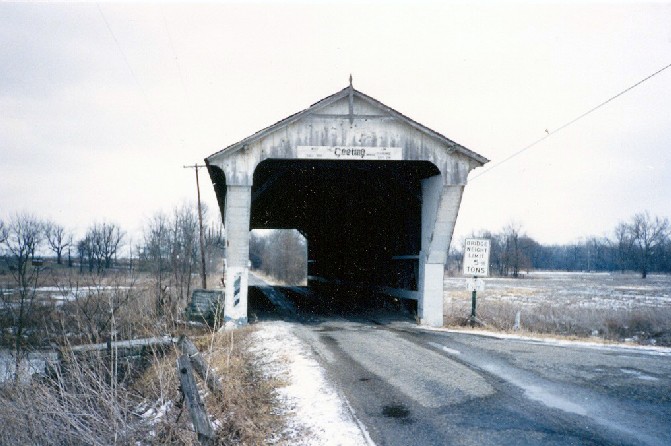
Geeting Bridge, Monroe, Preble County, OH Built 1894
Bill Eichelberger Photo, January 1987
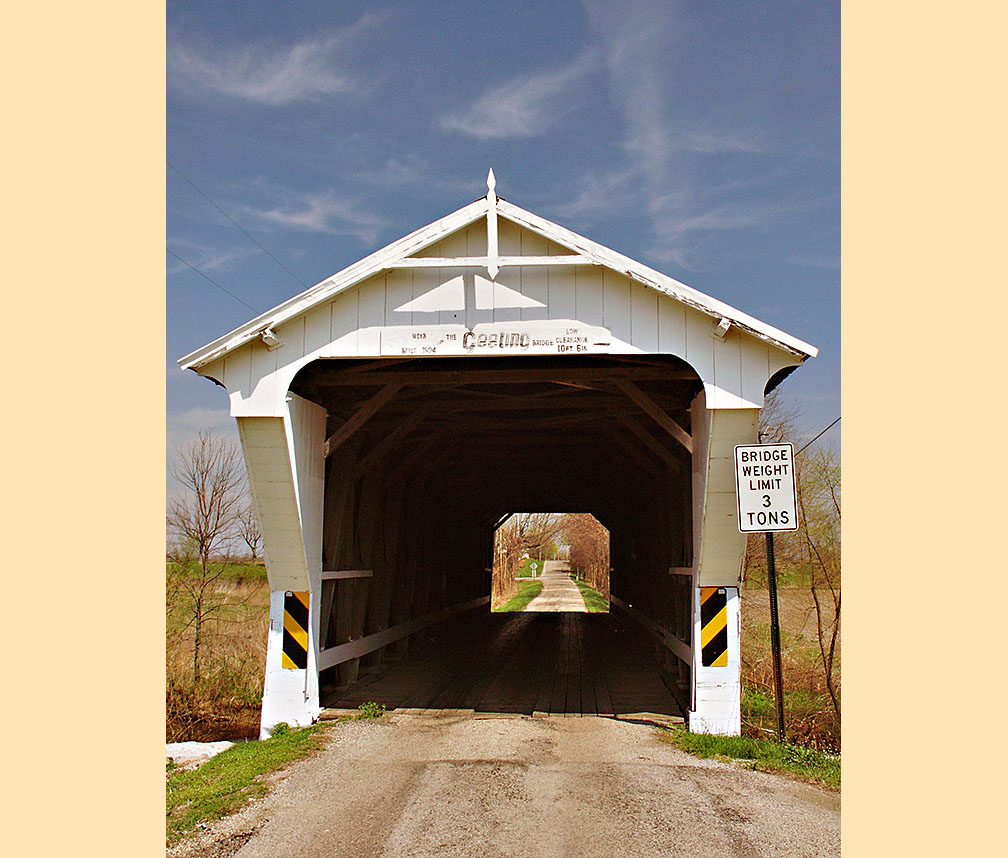

Geeting Bridge, Monroe, Preble County, OH Built 1894
Larry Cunningham Photo
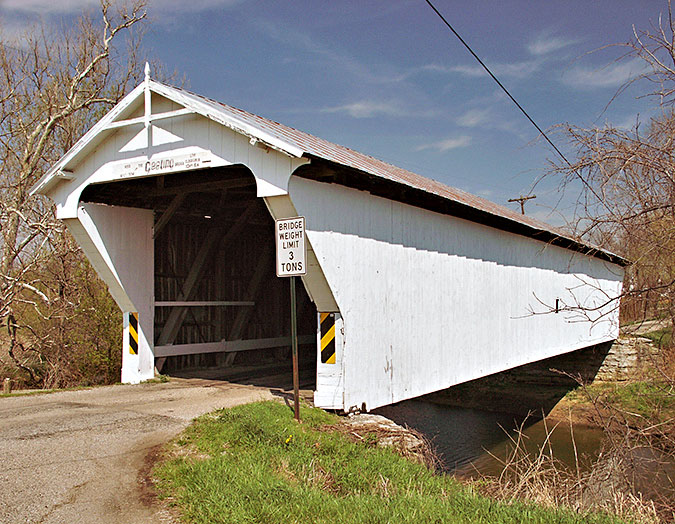

Geeting Bridge, Monroe, Preble County, OH Built 1894
Larry Cunningham Photo
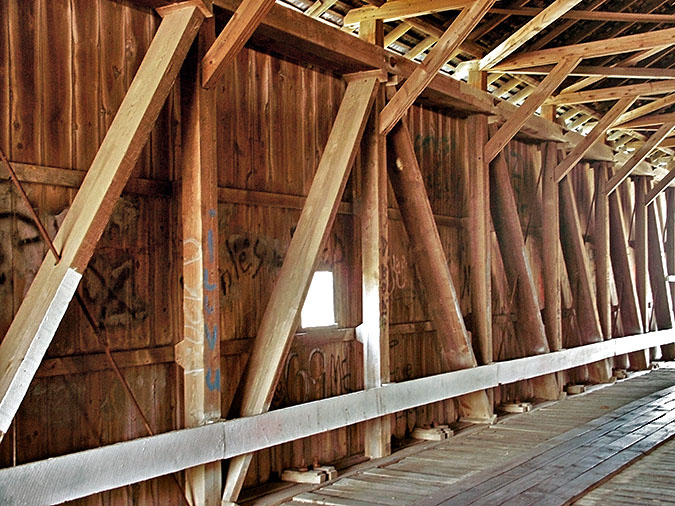

Geeting Bridge, Monroe, Preble County, OH Built 1894
Larry Cunningham Photo
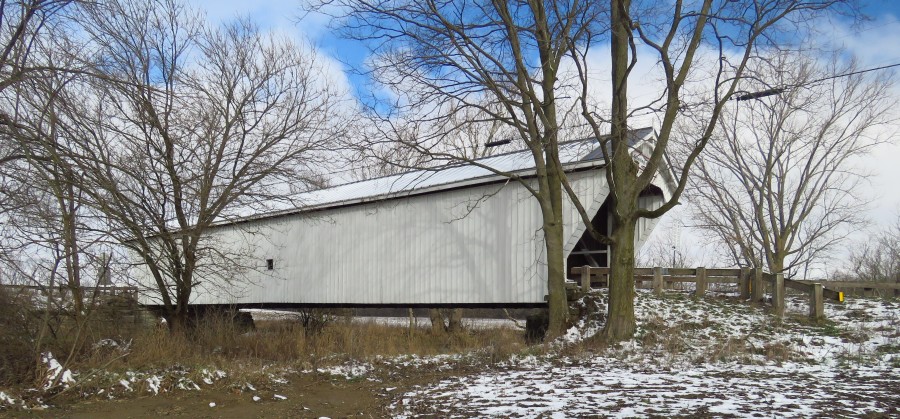

Geeting Bridge, Monroe, Preble County, OH Built 1894
Bill & Jenn Caswell Photo, March 15, 2020

Comments:
12-panel truss. Built at a cost of $2691.64. Per The Register-Herald (Eaton), May 18, 1960, "Our No. 13 covered bridge spans Price Creek on the Price Road in Monroe Township. It was built in 1893, the same year as the College Corner bridge. The changes on these two bridges, the addition of the corbels and gingerbread, were the last Mr. Sherman made and we can now trace the evolution of his Preble County bridges from the first one, No. 8, in 1887 to those two in 1893. The three built in 1887 had low clearance, light framing, 12 inch plain-edged siding, cut nails and skimpy shelter panels. Two were built in 1888 and the chief difference from those of the previous year was a higher vertical clearance. In 1889 this clearance went on up to slightly over twelve feet. All bridges built after 1889 were sturdier and more handsome in appearance. No. 10, the first one to be built in this style, had heavy framing, standardized panel length, 10 inch ship-lap siding, common nails, higher vertical clearance, more complete shelter panels and quarter-round molding for trim. After No. 10 was built in 1890, the final changes or additions were the corbels and gingerbread over the portals as stated above. No. 13 has a shed length of 112 feet; clear span of 94 feet; is square with the creek; has 12 bents; vertical clearance 12 feet 5 inches; outside width 18 feet 6 inches: roadway width 15 feet; and the original 2 inch beech flooring is topped with two narrow yellow-pine runways."
Sources:
Clark, Todd. Information received by email, April 2010
The Register-Herald (Eaton), May 18, 1960.
National Society For the Preservation of Covered Bridges. Covered Bridge Topics, Volume XV, No. 2, July 1957, page 5
Wood, Miriam. Ohio Covered Bridge Index, Preble County
Wood, Miriam F. & Simmons, David A.. Covered Bridges: Ohio, Kentucky, West Virginia, 2007, pages 149, 159
National Society for the Preservation of Covered Bridges. World Guide to Covered Bridges, 2021, page 83

Compilation 2026 Covered Spans of Yesteryear

The images in this collection may be protected under copyright law and may only be used for educational, teaching, and research purposes.
If the intended use is beyond these purposes, it is the responsibility of the user to obtain the appropriate permissions from the owner stated in the image's credits.


Home | Copyright Notice | Reports | Credits | Unidentified Bridges | FAQ | Links

www.lostbridges.org